Lively discussion: A world out of joint?
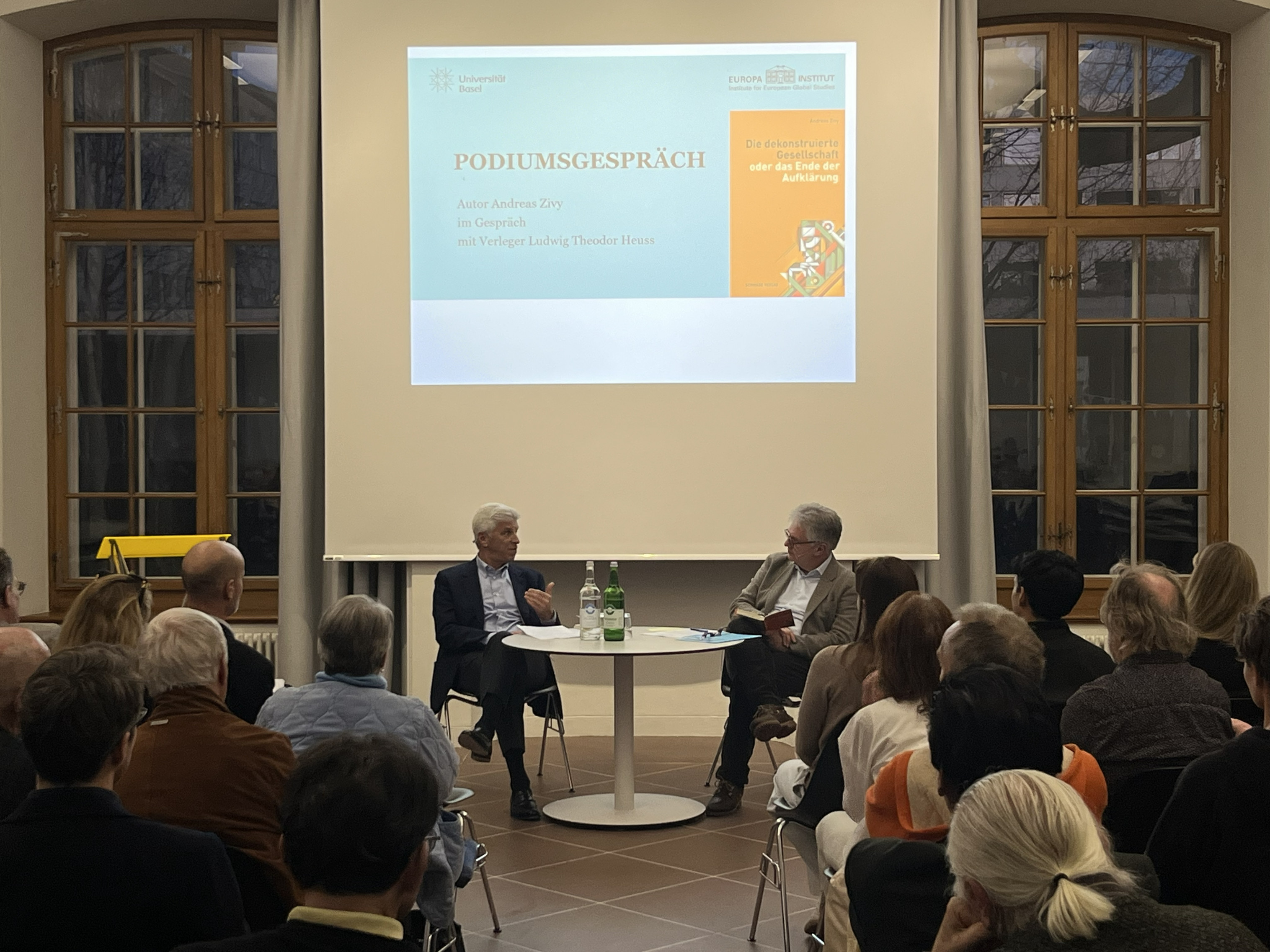
In collaboration with Schwabe Verlag and the Democracy Foundation Basel, a discussion evening was held in the Sandgrube on the topic “Auf/bruch in eine neue Welt?”. The director of the European Institute Prof. Dr. Corey Ross was able to welcome around 80 guests to the orangery, which was occupied down to the last place.
The event focused on the opening of Andreas Zivy's book entitled “The Deconstructed Society or the End of Enlightenment” (October 2025). The international trade entrepreneur from Basel read out some particularly pointed passages from the book before a lengthy conversation began between him and the presenter, Prof. Dr. Ludwig Theodor Heuss, in turn publisher of Schwabe Verlag and chairman of the Theodor Heuss Foundation and the Board of Trustees of the Friedrich-Naumann Foundation for Freedom.
As a result, the audience learned that frustrations with the course of the world, such as populism standing on the brink of success in some places, the emergence of social media that undermines truth and thus destroys democracy, or even a general failure of the elites (especially the business elite), were the reason why the author took up the pen in the first place. According to Zivy, the book is intended to provide a holistic explanation, not least for an accelerating dismantling of democracy. The concern for liberal democracy and “bourgeois enlightenment” (with its “blessings and downsides,” according to the author in the book) was clearly noticeable time and again.
Ask Heuss whether that wasn't simply a call for cash. Rather, and in the best case, a wake-up call, answered Zivy. He didn't want to be pessimistic, but rather alarmist — and annoyed himself about the sometimes nostalgic passages in the book. And so there was a lively back and forth and a wide arc was drawn, including the question of whether Switzerland, with its political system, might be better prepared against the dismantling of democracy. “Yes,” said Zivy.
Dr. Carlotta Manz and Prof. Ralph Weber then presented brief comments on the book. Manz pointed out the problem that the powerful players in the tech sector were hardly held accountable by politicians, not even in areas relevant to human rights. Weber questioned whether the feared end of the Enlightenment did not simply mean that Europe would arrive in the reality that many parts of the world have lived in for decades.
The numerous questions from the audience reflected the variety of aspects raised and then soon converged on a decisive point. Isn't the analysis provided by the book, which the world is already seeing way off the rails, ultimately too pessimistic? Couldn't at least some of the developments described be interpreted more optimistically? At this point, the ghosts gathered in the room divorced. An extremely lively evening of discussion ended with an emphatic vote from the audience that history neither repeats itself nor rhymes, but is in principle open to results, and that one could also draw courage and hope from this insight.
.jpg)